CNC Machined Parts
Custom CNC Machined Tooling and Fixture Components
Custom CNC machined jaws, locating blocks, rest pads and fixture components made from your drawings. One-off and low-volume multi-part RFQs.
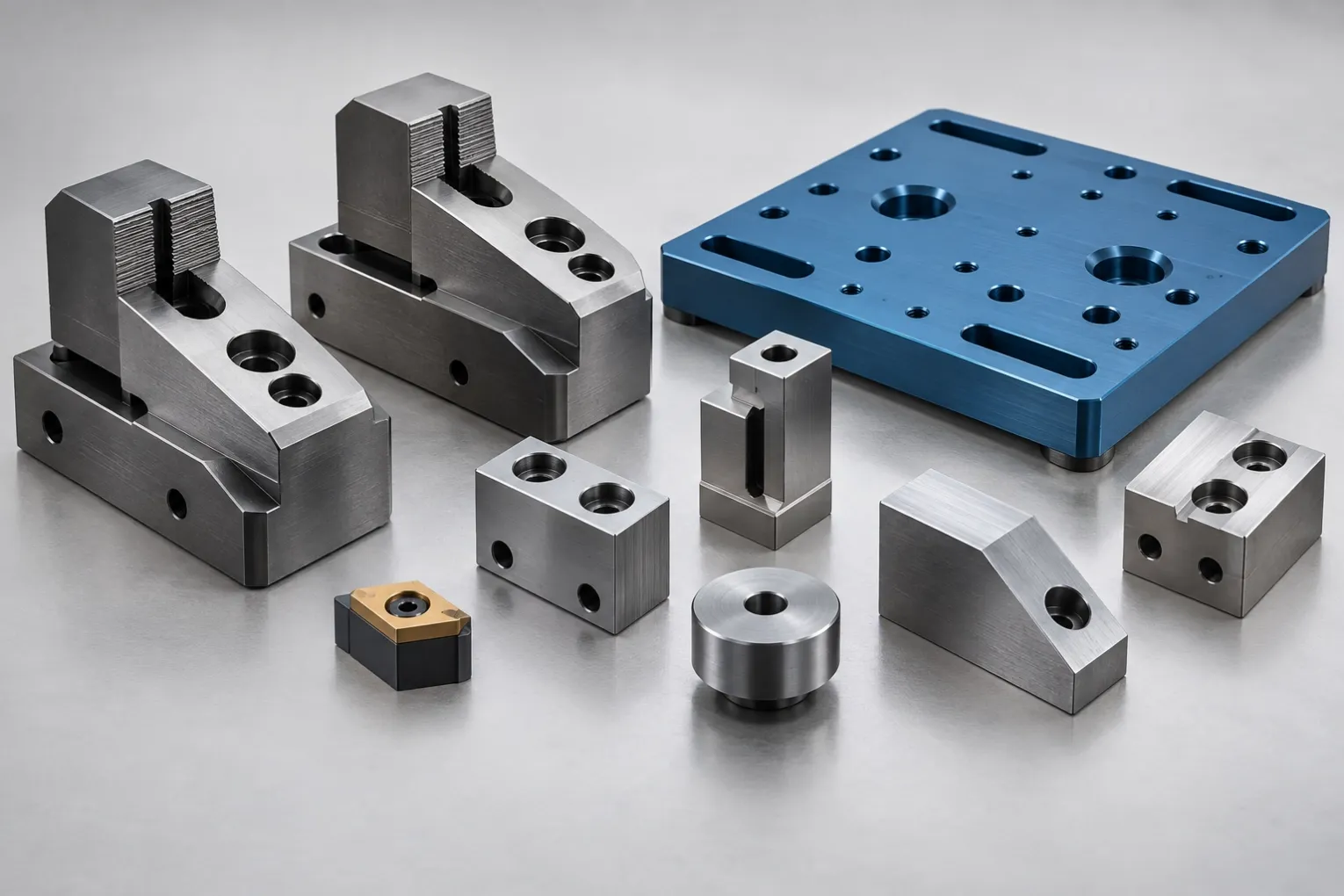
Illustrative examples of made-to-drawing tooling and fixture components. No customer drawings or proprietary geometries are shown.YSBK manufactures jaws, locating blocks, rest pads and other tooling components from customer drawings.
A single RFQ can include an A2 tool-steel jaw, a case-hardened gripping component and several aluminum plates. We review each part number separately because the material, quantity and manufacturing route may be different.
We support one-off replacement parts and low-volume tooling orders. Heat treatment, descaling, finish machining, grinding and laser marking can be included when specified in the drawing or quotation scope.
This service is for tooling companies, automation builders, machine shops and equipment manufacturers that already have released drawings. We manufacture individual components; we do not design or supply complete fixtures or robotic systems.
Send the drawings you already have. A clear 2D drawing can often be used for an initial quotation.
Typical Tooling and Fixture Components
Parts we review include:
- custom jaws and gripping components;
- locating blocks and datum components;
- rest pads and support blocks;
- fixture plates;
- mounting and adapter plates;
- nest components;
- clamp arms;
- tooling blocks;
- pins, shafts and bushings;
- wear components;
- replacement parts for existing fixtures.
These are examples, not standard catalogue products. The dimensions, material and functional requirements come from the customer’s released drawing.
If you need a standard jaw, clamp or fixture element identified by a catalogue number, an off-the-shelf tooling supplier may be a better source.
Several Part Numbers in One RFQ
Tooling projects often contain several different parts rather than a large quantity of one component.
You can send the related drawings together. For each part number, identify:
- current drawing revision;
- required quantity;
- material and material condition;
- heat treatment and final hardness;
- critical dimensions;
- surface or grinding requirements;
- part-marking requirements;
- inspection documents required with delivery.
We review and price each part separately within the same quotation package.
This is important when the drawings require different manufacturing routes. An aluminum mounting plate may need only CNC machining and deburring. A carbon-steel gripping component may require case hardening. An A2 tool-steel jaw may require heat treatment followed by finish machining or grinding.
A note shown on one drawing is not automatically applied to the other parts in the RFQ.
For projects containing several drawing numbers, a parts list helps connect each part number with its revision and quantity. See our build-to-print RFQ guide for the general information to include.
Quoting From a 2D Drawing
A clear 2D drawing can often support an initial quotation.
It should define the material, quantity, tolerances, threads, heat treatment and surface requirements that affect the finished part.
A STEP model becomes more important when a jaw or gripper contains:
- a curved contact profile;
- geometry that is difficult to interpret from standard views;
- intersecting features;
- several machining directions;
- surfaces whose orientation affects tool access or workholding.
Some customers release the STEP model after selecting a supplier. We can review the available 2D drawing first, but the manufacturing route must be checked again when the 3D file is received.
If the model reveals a feature that was unclear in the drawing, we confirm how it affects machining before production starts.
The drawing and model must represent the same revision. If they disagree, we need confirmation of the controlling file before manufacturing.
Read more about the different roles of 2D drawings and 3D CAD files in CNC quotations.
Heat-Treated Jaws and Wear Components
A final hardness value does not define the complete manufacturing route.
Before production, we check which features can be completed before heat treatment and which dimensions need to be controlled afterward.
Depending on the drawing, the quoted scope may include:
- rough CNC machining;
- case hardening or through hardening;
- descaling after heat treatment;
- finish machining;
- surface or cylindrical grinding;
- laser marking;
- final inspection.
A case-hardened carbon-steel component and an A2 tool-steel jaw require different process plans.
The drawing should identify the treatment method, final hardness and any case-depth requirement. It should also show which mating, locating or contact surfaces must remain controlled after treatment.
For tight post-hardening dimensions, machining allowance may be left for final machining or grinding. We do not assume that every surface needs grinding; the process follows the released requirements.
For more detail on material condition, heat treatment, grinding and corrosion protection, see our low-volume A2 tool steel machining guide.
Aluminum Plates in a Tooling Package
The same RFQ may also contain aluminum mounting or adapter plates.
These parts can appear simple, but the hole pattern may control how other components fit together. The drawing should distinguish between clearance holes, threaded holes, dowel locations and other features that determine assembly position.
On this page, aluminum plates are treated as part of a tooling-component package. Detailed information about datum relationships, mounting surfaces and hole patterns is available on our custom CNC machined mounting plates page.
What We Check Before Shipment
Inspection follows the released drawing rather than one generic checklist.
Depending on the part, we check:
- specified dimensions and tolerances;
- hole sizes and positions;
- locating and mounting features;
- machined profiles;
- mating or contact surfaces;
- drawing-defined edge conditions;
- completion of specified heat treatment and finishing;
- required laser marking.
We also examine the overall structure and required surface condition before packing.
Material certificates, hardness reports and dimensional reports are not automatically included with every order. If your quality system requires them, state the exact documents in the RFQ so they can be included in the quotation.
Packing, Rust Prevention and Part Identification
Different part numbers are packed separately to make receiving and assembly easier.
Hardened A2 tool-steel components may receive rust-preventive oil before packing. If oil is not acceptable because the part will be bonded, coated, cleaned or installed directly into sensitive equipment, tell us before production.
Identify any contact, locating or finished surfaces that require additional protection during transportation.
For a repeat order, confirm the current drawing revision. We recheck the material, quantity and processing requirements rather than relying only on the previous purchase.
Common Quotation Questions
Can you quote tooling components from 2D drawings only?
A clear 2D drawing can often support an initial quotation when it defines the material, quantity, tolerances, heat treatment and surface requirements. For curved jaw profiles or geometry that is difficult to interpret from drawing views, we review the STEP model before finalizing the manufacturing route.
Can several part numbers be included in one RFQ?
Yes. Send the related drawings together and list the quantity and requirements for each part number. We review and price each item separately within the quotation package.
Send Your Tooling Component RFQ
Please include:
- current 2D drawing;
- STEP or other 3D CAD file, if available;
- quantity for each part number;
- material and material condition;
- heat treatment and final hardness;
- critical tolerances and GD&T;
- surface or grinding requirements;
- laser-marking requirements;
- inspection reports or certificates required;
- packing and rust-protection restrictions;
- requested delivery date.
Several part numbers may be submitted in the same RFQ.